
Start by asking about one passage
This exercise uses the open-access paper by King et al. (2016). Download the PDF from the source link, import it in your project’s Reference library, and use the reference’s PDF button to open it. You can also open a PDF already attached to a reference. A bibliographic record alone is different from an attached full-text PDF.
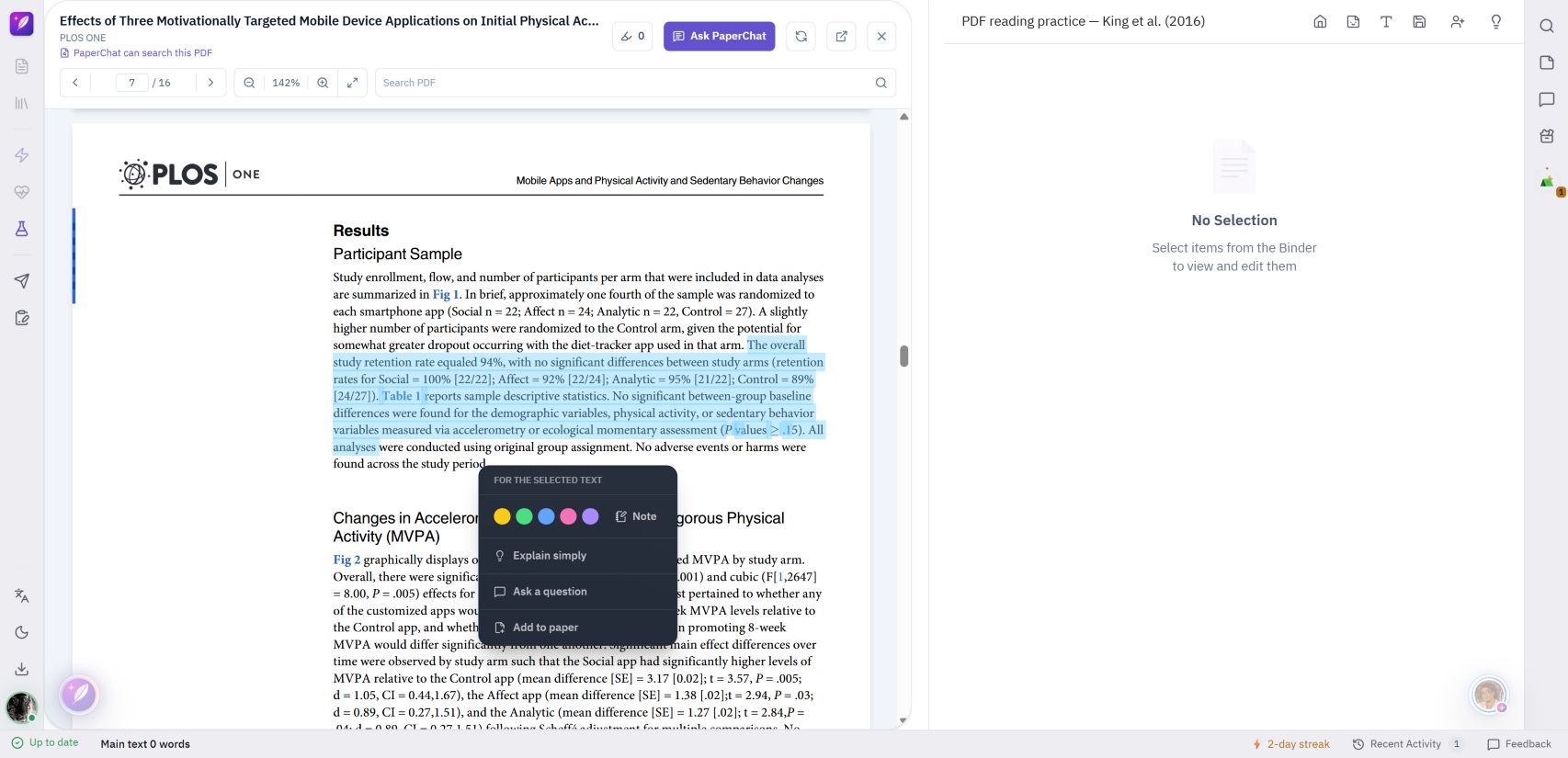
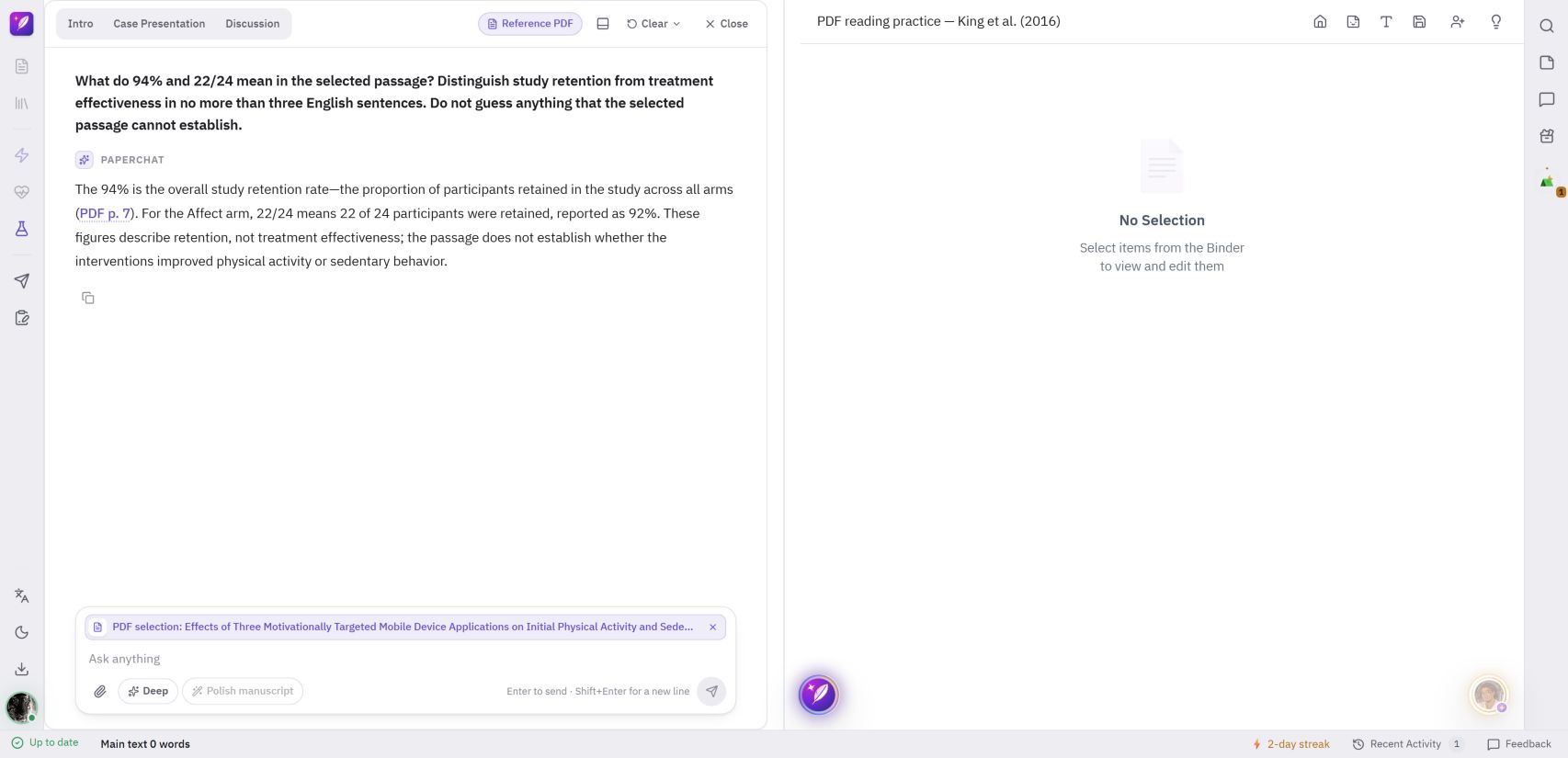
On PDF page 7, under Results → Participant Sample, select the passage about retention and group denominators. Choose “Ask a question” in the selection menu to open Paper Chat. Check the attached passage, enter the request below and send it. Selecting text and sending a question are separate steps.
What do 94% and 22/24 mean in the selected passage? Distinguish study retention from treatment effectiveness in no more than three English sentences. Do not guess anything that the selected passage cannot establish.
Decide what you need to learn before reading
Decide whether you need to explain the design at journal club, support background in an Introduction, or compare findings in a Discussion. Your purpose determines which participants and outcomes you must understand in detail.
Write four lines: your question, the population and setting you care about, the study design you need, and where you will use the paper. Mark differences between your intended population and the study’s participants. A clear AI explanation does not establish that the findings apply to your claim.
A whole-paper summary can help you get oriented. Follow it with focused questions. A short PDF summary may omit conditions you need for citation; keep both the claim you checked and its location, rather than only the summary.
Separate participants, methods, results and limitations
These prompts are general reading techniques, not promises about any particular tool. Supply the relevant material first. When only a selected passage is attached, do not assume the AI has read the whole paper; inspect the relevant Methods, Results or Discussion for missing context.
- Participants “Summarize the eligibility criteria and recruitment setting in this Methods passage. Mark unstated conditions as unknown.” Check age, setting, dates and exclusions in the original.
- Methods “Separate the design, comparator, primary outcome and measurement time.” Check allocation and actual measurements. Do not turn an observed association into a treatment effect.
- Results “What are the unit of analysis, denominator, measurement unit and time point? Explain adjustment and uncertainty only where stated.” Distinguish people, eyes, specimens and visits; inspect table rows, columns and footnotes.
- Limitations “Separate limitations stated by the authors from additional interpretations to investigate.” Do not cite an AI-suggested possibility as something the authors wrote.
Practice checking the response against the original
Pick one sentence you intend to cite and identify its population, numbers and conditions. Read the surrounding paragraph, then the table or figure heading and footnotes. Even when the AI gives a page number, check the actual content. Viewer page numbers and printed journal pages can differ.
Follow these locations in the practice paper. This table is a small reading exercise, not a complete appraisal or a new analysis.
| Check | Location | What to compare |
|---|---|---|
| Population and period | Page 3, Methods | Check eligibility for underactive adults aged 45 or older and the eight-week study period. |
| Denominator | Page 7, Results; page 8, Fig 1 | 94% is retention. In the Affect arm, 22/24 means retained/allocated participants, not the total sample or treatment success. |
| Table units | Page 9, Table 1 | Distinguish baseline activity in min/day from self-reported sitting in hr/day. |
| Limitations | Page 13, Discussion | Check the authors’ small-sample and short-duration limitations; do not infer sustained effects. |
- Check what the number measures. A percentage changes meaning with its denominator. Keep whole-sample and subgroup results, and baseline and follow-up measurements, separate. Effect sizes, confidence intervals and P values are not interchangeable.
- Check publisher updates. A 2016 correction replaces an incorrect Fig 2 image in this paper. Open the correction linked below rather than relying only on the figure in a previously downloaded PDF.
Check reference identity, corrections and claim–evidence alignment →
Check the scope of your Paper Buddy question
The verified deployed path is Reference library → import a PDF or open an existing reference PDF → select text → Ask a question → send your request. “Explain simply” requests an explanation of the passage; “Add to paper” starts a manuscript-use request. This exercise uses “Ask a question” so that you can specify the question yourself.
The PDF toolbar also has “Ask PaperChat” for asking about the document. Distinguish it from the selection menu and inspect the material attached before sending. A document-question path does not guarantee that every page, table or image is understood or verified.
If text selection or question preparation is unavailable, check whether the PDF has extractable text and read the app’s message. Before sending, check that the selected passage is attached; leave anything you cannot verify marked as unknown. See the comparison guide when choosing tools for other tasks.
Connect a checked paper to a manuscript citation
Keep a note with four fields: claim for my manuscript / original location / population, time and units / limits of applicability. Cite the paper you checked, not the AI response. Saving a paper in the library and inserting a citation are separate actions.
Choose the citation position in your manuscript, cite the reference, then check that the in-text marker and bibliography entry identify the same paper. Verify title, authors, year and DOI. The citation guide covers the detailed steps and bibliography formatting.
Avoid common reading mistakes
Common traps include citing after reading only the abstract, treating a subgroup result as the overall result, and trusting a translation while overlooking qualifications in the original. Fluent wording is not proof of sufficient evidence. Ask again: in whom, what was measured, and when?
Requesting a source location helps you begin checking. It does not itself verify the claim. Leave values you cannot locate marked as unknown, read the necessary passages and then decide whether to cite.
Before closing the paper, keep one question and one original location you checked. One passage is a useful first session. Next time, connect the eligibility criteria in Methods, the denominator in Results and the limitations in Discussion.
Frequently asked questions
Can I cite a paper after reading only an AI summary?
Use the summary for orientation. Before citing a claim, check the population, design, results and limitations in the original, and ensure your sentence stays within that scope.
Is an AI-provided supporting sentence or page number enough?
Read the surrounding paragraph and check table denominators, units, time points and footnotes. Separate the authors’ conclusions from AI interpretation, and check publisher corrections.
Sources and how we checked them
The deployed PDF import and passage-question workflow, publisher article and correction were checked on November 9, 2026. The paper shown is by King et al., PLOS ONE, reproduced with author and source attribution under CC BY. Use the source links to check the PDF and corrected figure together.
- King AC et al. (2016). Effects of Three Motivationally Targeted Mobile Device Applications on Initial Physical Activity and Sedentary Behavior Change in Midlife and Older Adults: A Randomized Trial. PLOS ONE 11(6): e0156370. CC BY.
- King et al. — PDF (16 pages)
- PLOS ONE (2016) — Correction, Fig 2. doi:10.1371/journal.pone.0160113